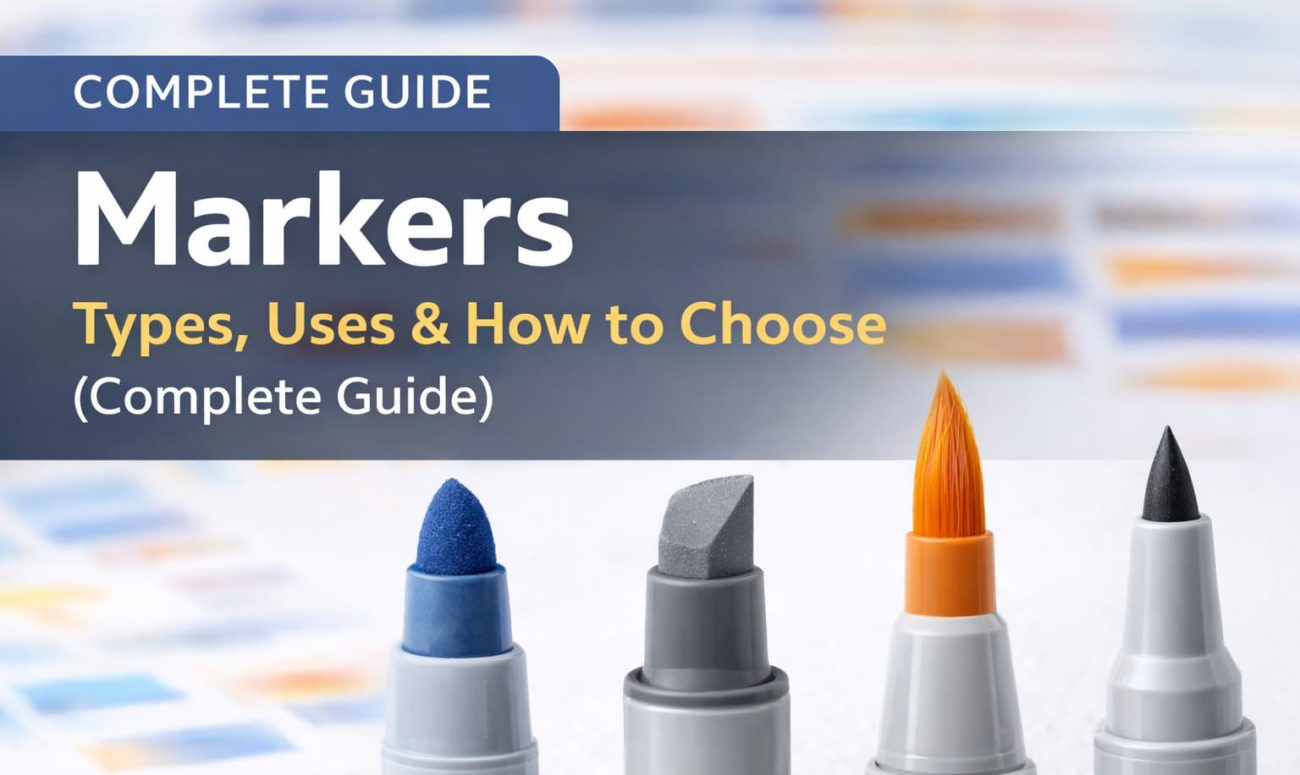
Markers: Types, Uses & How to Choose (Complete Guide)

Markers types uses and how to choose complete guide cover image
types of markers overview by ink system and tip type

Markers are used everywhere—from kids’ classrooms and office planning to packaging, crafts, and professional illustration. But “the best marker” depends on more than color. Ink system, tip shape, drying time, bleed-through, and surface compatibility all change how a marker performs in real use.

This complete guide breaks down the main types of markers by ink (water-based, alcohol-based, permanent, paint, chalk) and by tip (bullet, chisel, brush, fine). You’ll also get a quick decision table, scenario-based recommendations, and a practical buyer checklist for bulk or private-label programs.

Quick Decision Table: Choose a Marker in 30 Seconds

Use case

Best ink type

Best tip

Works on

Watch-outs

Kids / School

Water-based

Bullet / fine

Paper, coloring books

Can feather on thin paper

Office / Planning

Water-based or permanent

Fine / bullet

Paper, labels

Permanent ink won’t erase easily

Drawing / Illustration

Alcohol-based

Brush + chisel

Marker paper, thicker paper

Bleed-through on thin paper

Labeling / Packaging

Permanent

Fine / chisel

Cardboard, plastic, metal

Smearing before fully dry

Craft / Signage

Chalk or paint

Chisel / bullet

Glass, acrylic, metal

Removal depends on surface

Industrial / Workshop

Permanent or paint

Chisel / bullet

Multi-surface

Ventilation & compliance needs

What Are Markers?

A marker (also called a marker pen) is a pen-style writing tool that uses a porous tip (often fiber/felt) to deliver ink at a higher flow rate than typical pens. That higher flow is what creates bold, fast coverage—but it also introduces differences in drying, bleeding, and durability.

To choose the right marker, focus on four variables:

  • Ink system: water-based, alcohol-based, permanent, paint, chalk
  • Tip type: bullet, chisel, brush, fine/ultra-fine
  • Surface & paper: porous vs non-porous materials
  • Use conditions: speed, odor, safety, smudge resistance, permanence

Types of Markers by Ink

Water-Based Markers

Best for: kids, schools, everyday coloring, light sketching, planners
Water-based markers use water-soluble dyes or pigments. They’re popular because they tend to be lower odor and easier to clean up than solvent-heavy markers.

Why people choose them:

  • Generally lower odor and more classroom-friendly

  • Often less bleed-through than alcohol markers (paper still matters)

  • Good control for writing, coloring, and basic art

Common issues & fixes:

  • Feathering on thin paper: use thicker paper or marker paper

  • Streaking with large fills: use a broader tip or slower stroke overlap

Alcohol-Based Markers

Best for: illustration, blending, shading, vivid color coverage
Alcohol-based markers use fast-evaporating solvents that dry quickly and make blending easier—especially for layered artwork.

Why people choose them:

  • Vibrant colors and smoother large-area coverage
  • Excellent blending and layering (especially with brush tips)
  • Fast drying reduces smudges in many workflows

Common issues & fixes:

  • Bleed-through on thin paper: use marker paper or a backing sheet
  • Dry-out risk if caps don’t seal well: choose better sealing designs; store properly
water based vs alcohol based markers bleed through and color intensity comparison

Permanent Markers

Best for: labeling, packaging, warehouse use, multi-surface marking
Permanent markers are designed for durability and water resistance on a wider range of surfaces (plastic, metal, cardboard). They’re common in industrial and office settings.

Why people choose them:

  • Strong adhesion and smudge resistance once cured

  • Better for non-porous surfaces than typical water-based inks

  • Practical for shipping marks, cartons, storage bins, and tags

Common issues & fixes:

  • Smearing before fully dry: allow a few seconds more on slick surfaces

  • Odor/ventilation needs: choose compliance-friendly formulas for your market

Paint Markers

Best for: crafts, signage, DIY, industrial marking where coverage matters
Paint markers lay down a paint-like layer (often opaque), which makes them useful on dark surfaces and non-porous materials.

Why people choose them:

  • Opaque coverage on metal, glass, plastic, wood

  • Good for high-contrast marking and decoration

  • Often more visible than dye-based inks

Common issues & fixes:

  • Nib clogging: cap tightly; follow storage instructions

  • Longer dry/cure time: allow curing before handling

Chalk Markers

Best for: temporary signage on smooth surfaces (glass, acrylic boards)
Chalk markers create a chalk-like look but apply like ink. Many are designed to be removable from non-porous surfaces.

Why people choose them:

  • Bold, matte “chalk” appearance

  • Often erasable on the right surfaces

  • Great for menus, windows, and event signage

Common issues & fixes:

  • Hard-to-remove residue: test on your exact surface first

  • Not ideal on porous surfaces: can stain paper or unfinished wood

Types of Markers by Tip

Tip style controls line width, precision, and fill speed. For many buyers, tip choice matters as much as ink.

Bullet Tip (Round)

Best for: general writing, coloring, school, everyday use

  • Stable line, easy control

  • Great all-around option

  • Watch-outs: can feel slower when filling large areas

Chisel Tip

Best for: broad strokes, labeling, signage, callouts

  • Offers both thick and thin lines depending on angle

  • Efficient for filling and bold lettering

  • Watch-outs: can feel “too wide” for fine detail

Brush Tip

Best for: illustration, calligraphy, shading, expressive strokes

  • Variable line width with pressure

  • Excellent for blending and dynamic strokes

  • Watch-outs: tip wear/fraying matters a lot—quality varies

Fine / Ultra-Fine Tip

Best for: technical lines, notes, labeling, detail work

  • Precise control and consistent thin lines

  • Useful for templates, charts, and small writing

  • Watch-outs: can feel scratchy if the tip fiber is low-quality

Felt Tip Pens & Felt Tip Markers (What They Really Mean)

Many people use “felt tip pens,” “felt tip markers,” and even “marker felt pens” interchangeably. In most cases, felt tip describes the tip structure—a porous fiber tip that holds and releases ink—rather than the ink type itself.

That means you can find:

  • Water-based felt tip pens for school and coloring

  • Alcohol-based felt tip markers for illustration and blending

  • Felt tips across multiple marker categories, depending on use

Mini Guide: Felt Tip by Scenario

Scenario

Recommended felt tip setup

Why

Kids / School

Water-based + bullet/fine

Lower odor, easier handling

Drawing / illustration

Alcohol-based + brush/chisel

Blending + fast coverage

Office / labeling

Permanent + fine/bullet

Clear lines, durable marks

Best Uses by Scenario

For Kids & Schools

Choose water-based markers with bullet or fine tips. Prioritize low odor, washable options (if your market needs it), and better paper to reduce feathering.

For Office & Planning

If you mainly write on paper, water-based markers can work well. For labels, storage bins, or packaging where durability matters, a permanent marker with a fine tip is usually more reliable.

For Drawing & Illustration

For blending and vivid colors, alcohol-based markers with brush + chisel tips are common. Use marker paper to reduce bleed-through and get smoother gradients.

For Labeling & Packaging

Use permanent markers for cartons, tags, and multi-surface labeling. For very dark surfaces or when you need opaque coverage, consider paint markers instead.

For Non-Porous Surfaces (Plastic / Metal / Glass)

Most water-based inks struggle on slick surfaces. A permanent or paint marker is often more suitable. Always test dry time and smear resistance on your exact substrate.

Building a repeatable marker program?

Explore our OEM/ODM Marker Program — share ink type, tip, colors, logo method, packaging format, and expected quantity to get a faster quote.

FAQS

What are the main types of markers?

Most markers fall into water-based, alcohol-based, permanent, paint, and chalk categories—each suited to different surfaces and use cases.

What’s the difference between felt tip pens and markers?

In many cases there’s no strict difference—“felt tip” describes the porous fiber tip. The ink type (water/alcohol/permanent) determines performance.

Are water-based markers safe for kids?

Water-based markers are commonly chosen for classrooms due to lower odor and easier cleanup, but always confirm the safety claims and compliance required in your market.

Do alcohol-based markers bleed through paper?

They often can on thin paper due to fast ink flow. Marker paper or thicker stock helps reduce bleed-through.

Which marker tip is best: bullet, chisel, brush, or fine?

Bullet is general-purpose, chisel is fast for bold strokes, brush is best for expressive art, and fine is best for detail and labeling.

What markers are best for illustration and blending?

Alcohol-based markers with brush/chisel tips are widely used for layering and blending, especially on marker paper.

Why do markers feather or spread on paper?

Feathering is usually caused by paper fibers wicking ink. Better paper, slower stroke overlap, and a more controlled ink flow reduce it.

What markers work best on plastic, metal, or glass?

Permanent markers and paint markers typically perform better on non-porous surfaces than water-based inks.

How do I prevent markers from drying out?

Cap sealing quality and storage matter. Choose designs with reliable cap fit and store markers tightly capped, away from heat.

Accordion title. Click here to edit
Click here to change this text. Ac non ac hac ullamcorper rhoncus velit maecenas convallis torquent elit accumsan eu est pulvinar pretium congue a vestibulum suspendisse scelerisque condimentum parturient quam.Aliquet faucibus condimentum amet nam a nascetur suspendisse habitant a mollis senectus suscipit a vestibulum primis molestie parturient aptent nisi aenean.A scelerisque quam consectetur condimentum risus lobortis cum dignissim mi fusce primis rhoncus a rhoncus bibendum parturient condimentum odio a justo a et mollis pulvinar venenatis metus sodales elementum.Parturient ullamcorper natoque mi sagittis a nibh nisi a suspendisse a.
What should I check when buying markers in bulk?

Focus on consistency: sealing, writing length, tip wear, line-width tolerance, color repeatability, leakage testing, packaging, and lead time.